








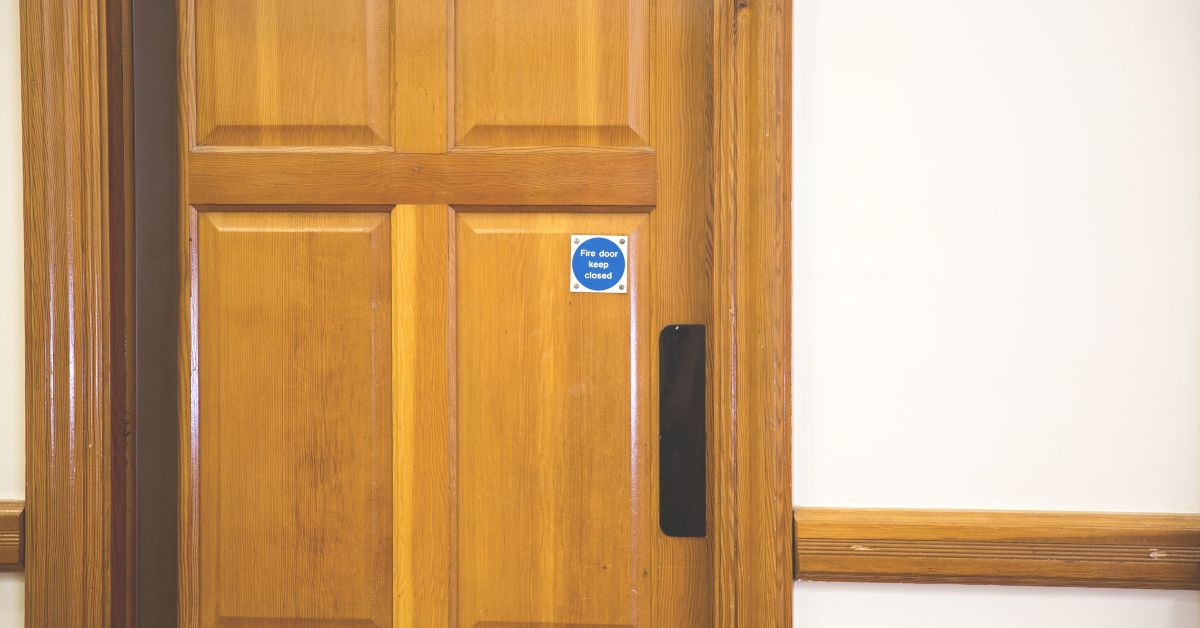
Every year, Fire Door Safety Week offers a timely reminder for landlords to pay attention to the vital importance of fire doors.
Fire doors
For most of the time, a fire door works just like any other door as a way of getting into and out of a room. Unlike other doors, however, a fire door is specifically designed to be part of a passive fire protection or safety system.
A fire door is intended to keep any fire within the room in which it started, so protecting the occupants and providing an escape route through which others may leave the burning building.
They play such an important, potentially life-saving function that fire doors are obligatory in all factories, offices, and public buildings.
Perhaps less well appreciated is that fire doors are also required in houses in which there is a habitable room on the second floor – such as in a loft conversion – townhouses of two storeys or more, and in rooms that open into an integral garage.
Most important of all – as far as landlords are concerned – they are also required in flats and Houses in Multiple Occupation (HMOs).
Fire doors in flats and HMOs
Indeed, fire doors are so critical to residents’ safety that in 2022 amendments were made to article 24 of the Regulatory Reform (Fire Safety) Order 2005 (Fire Safety Order) that stress their use in high-rise buildings and those in multi-occupancy.
In the wake of the tragic fire in the Grenfell tower block in 2017, the amendments to the regulations also focus on ensuring that local Fire and Rescue Services have as much information as possible about the management of fire risks in high-rise buildings.
If you are a landlord, you have a general duty to follow the published fire safety regulations that apply to either a purpose-built block of flats or a house converted into flats or used as an HMO.
So that you better understand quite what is involved in complying with these regulations, the organisers of Fire Safety Week have published a Fire Door Safety Week Toolkit – a collection of resources that will help landlords check the safe installation, operation, and maintenance of those fire doors for which they are responsible.
Maintaining safety throughout a let property
Underlying publications by the government and reinforced in the Fire Safety Week’s material is the landlord’s responsibility for maintaining fire safety through the formulation of a comprehensive fire risk assessment of your let property.
Assessments need to determine what fire risks there are to the property, the level of hazard to your tenants and their visitors, and the measures you need to take to control or at least mitigate those risks.
There are strict rules on the installation of smoke alarms and CO2 detectors in many HMOs, but your risk assessment also needs to consider the standard and effectiveness of the fire doors you have fitted.
It is also worth bearing in mind that, alongside meeting licensing conditions and your wider responsibilities as a landlord, fire safety obligations form part of your overall duty of care. Where appropriate fire risk assessments are not carried out, or reasonable measures are not taken to manage identified risks, this could have legal and financial implications.
In certain circumstances, tenants or visitors who are injured, or whose belongings are damaged as a result of a fire, may seek compensation. Any such outcomes would depend on the specific circumstances involved and the steps taken to manage fire safety, as well as the terms and conditions of any relevant insurance cover.
Even if you had the foresight to arrange landlord’s liability indemnity insurance, any settlement may be adversely affected by your failures, regarded as a function of your contributory negligence, and the amount paid out in insurance reduced accordingly.
Landlords might want to take particular attention to Fire Safety Week, therefore. Check the quality, standard and effectiveness of your fire doors – and you may not only help protect the health and safety of your tenants but avoid considerable additional expense.
Practical considerations for landlords managing fire door safety
Beyond understanding when fire doors are required, landlords may also wish to consider how fire door safety is managed on an ongoing basis. Fire doors are not a “fit and forget” feature and their effectiveness can reduce over time through wear, damage or unauthorised alterations.
Regular visual inspections may help identify common issues such as damaged door frames, missing or damaged intumescent strips, faulty self-closing mechanisms or excessive gaps around the door. In flats and HMOs, where doors may be used frequently, this type of wear can develop gradually and may not always be obvious without deliberate checks.
Responsibility for inspections and maintenance will depend on the type of property and how it is managed. In some blocks of flats, for example, freeholders or managing agents may be responsible for communal fire doors, while individual leaseholders or landlords remain responsible for flat entrance doors. Clarifying these responsibilities can help avoid gaps in compliance and reduce uncertainty should issues arise.
Record-keeping is another important aspect of fire door management. Maintaining clear records of inspections, maintenance work and any remedial action taken may help demonstrate that reasonable steps have been taken to manage fire risks. This documentation can also be helpful during licensing inspections, fire safety audits or insurance discussions.
It may also be appropriate to consider professional support. Competent contractors with experience in fire door installation and inspection can provide reassurance that doors meet the required standards and continue to function as intended. Where remedial work is recommended, addressing issues promptly may help reduce risk to occupants.
From an insurance perspective, fire door safety forms part of the wider risk profile of a let property. While insurance policies cannot prevent incidents from occurring, insurers may expect landlords to comply with relevant legislation and take reasonable precautions to manage known risks. Failure to do so could affect how a claim is assessed, subject to policy terms, conditions and exclusions.
Finally, communication with tenants should not be overlooked. Tenants may not always appreciate the importance of fire doors and may, for convenience, wedge them open or tamper with closers. Providing clear guidance on fire safety expectations and encouraging tenants to report damage or defects may help support safer outcomes for everyone involved.
Further reading: A Landlords Guide to HMOs, Fire doors and landlords and Fire safety rules for UK holiday home owners renting out their property.